
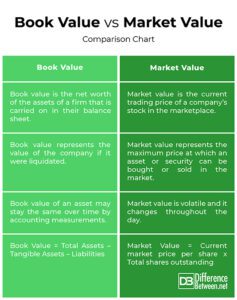
E-book valuation may be too high if the corporate is a bankruptcy candidate and has liens towards its assets. What is extra, assets will not fetch their full values if collectors promote them in a depressed market at fire-sale prices. Nonetheless, most commonly, guide worth is the value of an asset as it appears on the balance sheet. This is calculated by subtracting the amassed depreciation from the value of the asset. It is a longtime accounting follow that an asset is held based mostly on its original prices, even when the market value of the asset has changed considerably since its buy. To calculate E-book Value, you subtract liabilities (like debt) from property (things like property, tools, and inventory).
Market Value Equates To E-book Value

Accurate identification requires integrating these valuation metrics within broader market conditions. A common method involves the Price-to-Book (P/B) ratio, which compares a stock’s market price to its guide worth. A P/B ratio below 1 could counsel an undervalued inventory, whereas a ratio above 1 might point out overvaluation, although context matters. Basic analysis further examines earnings, money flows, and development prospects to assess true value relative to market worth. Basic evaluation methods are essential instruments for distinguishing between e-book and market value by evaluating a company’s intrinsic value. They embody varied strategies to assess monetary health, profitability, and growth prospects.
- Market value—also generally known as market cap—is calculated by multiplying a company’s outstanding shares by its current market value.
- NAV takes into account the present market worth of belongings and liabilities, which makes it extra reflective of a fund’s real-time price.
- If everyone thinks a specific inventory is value more than its book worth as a result of they consider it will perform nicely, the market worth might surge method above the e-book value.
- From primary accounting principles, we can derive that the guide value helps determine the worth of a company’s equity.
Buying And Selling Wti Cfds
E-book worth is determined by subtracting complete liabilities from complete belongings on a company’s steadiness sheet. Figuring Out undervalued or overvalued shares is a basic facet of worth investing, and it relies closely on comparing a company’s market worth to its intrinsic worth. Investors use numerous analytical tools to determine whether or not a inventory is buying and selling below its true value, indicating potential undervaluation, or above it, suggesting overvaluation. By analyzing the divergence between book and market worth, buyers acquire perception right into a company’s true financial well being and market expectations.
The Position Of Future Earnings And Investor Sentiment
Basic evaluation includes analyzing monetary statements, money circulate, and earnings to assess intrinsic worth versus present market worth. Book value emphasizes tangible assets and historical price accounting, whereas market worth considers future development potential and intangible assets. This divergence can result in situations the place a company’s market worth greatly exceeds or falls under its e-book worth.
Their names derive from the fact that these are the values carried on an organization’s books, making them unbiased of current financial or financial considerations. E-book worth can discuss with a quantity of different monetary figures whereas carrying worth is used in business accounting and is usually differentiated from market worth. In most contexts, book worth and carrying worth describe the identical accounting ideas. In these cases, their distinction lies primarily within the types of companies that use each one.
E-book worth per share represents the value of a company’s fairness on a per-share basis. It’s calculated by dividing complete shareholders’ equity by the number of outstanding shares. This metric indicates the minimum quantity a shareholder would possibly obtain per share if the corporate https://www.simple-accounting.org/ were liquidated. Effective administration of inventory is essential for sustaining accurate receipts and tracking withdrawals inside a company’s operations.
To be used as a decision-making software, it needs to be compared to an organization’s market worth before an investor can decide whether or not to buy or sell a stock. A company with a low E-book Worth but an innovative, scalable product (a development stock) will command a excessive Market Worth as a end result of the market anticipates huge earnings years from now. In these circumstances, the market sees no purpose to worth an organization in one other way from its belongings. When an asset is initially acquired, its carrying worth is the original value of its buy.
Moreover, depreciation-linked rules and accounting practices can create other issues. For occasion, a company could need to report an overly high worth for a few of its equipment. That could happen if it always makes use of straight-line depreciation as a matter of policy.
It may be extremely volatile, topic to market sentiment, and will not necessarily reflect an organization’s true intrinsic worth. Market values can be influenced by short-term fluctuations and even market manias and panics, which can distort the true worth of an organization. Moreover, as businesses increasingly rely on intangible assets, corresponding to mental property, the calculation of guide value may not adequately capture their worth. To address this issue, accountants want to search out consistent ways to value intangible assets.

Firms with lots of actual property, equipment, stock, and gear are most likely to have massive e-book values. In contrast, gaming companies, consultancies, style designers, and trading companies might have very little. They primarily depend on human capital, which is a measure of the economic value of an employee’s talent set.
For instance, if a company’s stock is buying and selling beneath its E-book Value, some traders would possibly see it as a great deal. Real-world case studies vividly illustrate situations where guide value and market worth diverge significantly, offering valuable insights for buyers. For example, in the course of the 2008 financial crisis, some monetary institutions’ market values plummeted despite their comparatively secure book values. This discrepancy reflected market sentiment and perceived future dangers rather than fundamental asset value. Such circumstances underscore the significance of analyzing each values fastidiously in value investing. Understanding these dynamics assists investors in distinguishing between book and market worth.